Craterless Hoba reveals (some of) its secrets Thu 23 April 2026
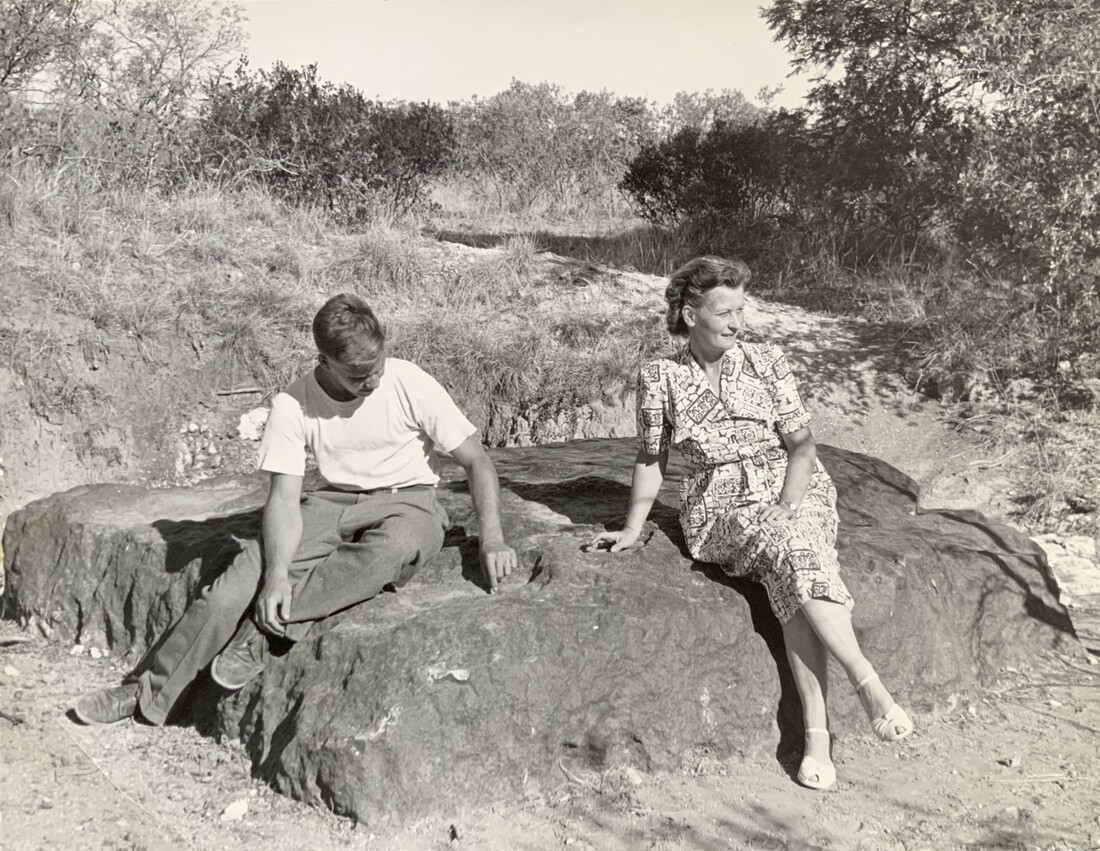
Unnamed male left, Ora Scheel right, Hoba below. 1952. Source: Hoba meteorite - Wikipedia
The world's biggest meteorite poses a big problem.
When it landed, it should have blasted out a big crater.
Instead, it embedded itself level with the topsoil. Leaving scientists a minor job digging it out - and a major job explaining it.
How exactly did a 50+ ton slab of nickel-iron alloy slab decelerate to a gentle touchdown on the Namibian plain?
Scientists have proposed that Hoba approached Earth at a low angle, skipping like a flat stone through the atmosphere until it settled into place.
But when skeptics asked for evidence of Hoba's earlier touchdowns and of its final skid to a halt, skipping-stone theory cratered.
Like a reserve parachute, a new explanation was deployed.
From Hoba:
This meteorite has a flat shape, which has led some scientists to believe that it did not rotate as it entered the atmosphere and fell as a flat disc, which may have moderated its velocity and prevented the formation of a crater.
Both theories are ridiculous 1.
Fortunately, when theories can't fit the facts, the facts can be changed.
In 1955 the public was told Hoba was theirs, its site a national park.
Hoba's new owners were promptly denied access.
When they were allowed back 32 years later, they found that Namibian mining company Roessing Uranium Ltd had carefully rearranged Hoba's landscape:
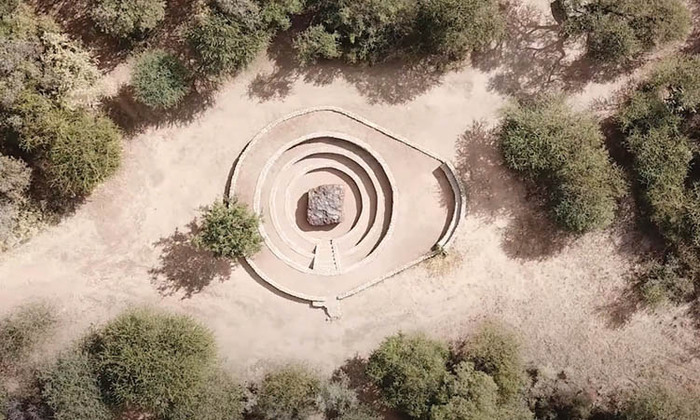
Stairway to Hoba. Source: Hoba meteorite, a fallen ‘shooting star’!
Hoba's authentic, newly-landscaped rim even includes steps to help show the metal mass is somehow 'down in the ground'.
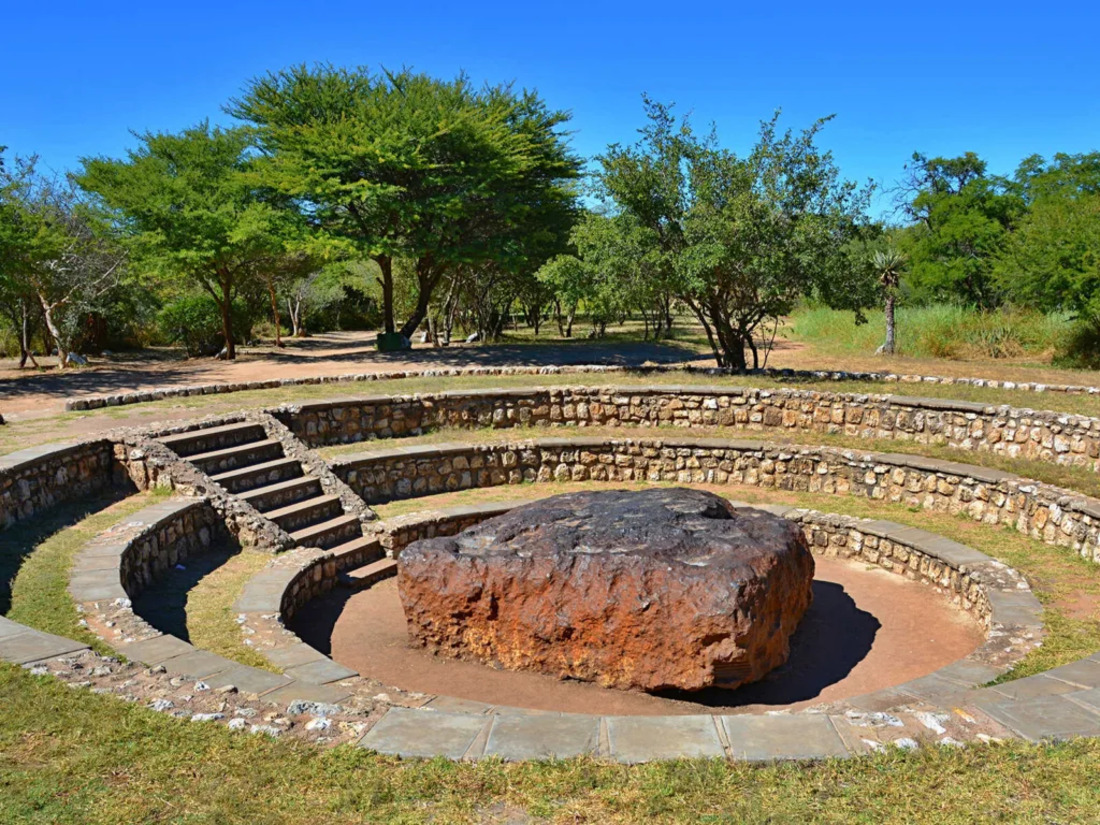
They're stonewalling you. Source: The Hoba Meteorite, Namibia Largest Known Meteorite on Earth - Geology Science
Now the facts fit a theory.
The two unnecessary steps - the little one at top and the little one at bottom - help raise the step-count from six to eight. In their subtle, low-rise way, they enhance Hoba's descent into fiction.
Hoba isn't alone. 17 of the 20 largest meteorites found on Earth also failed to make craters.
These crater-less sites are the black markers on the map below.
The three multi-ton, nickel-iron alloy chunks 2 3 that allegedly did make craters are clustered in one location.
They're the red markers on the map below:
Red marks the cover-up. Data source: List of largest meteorites on Earth - Wikipedia
Key:
- Black marker: Meteorite without crater
- Red marker: Meteorite with alleged crater
The map shows 17 multi-ton nickel-iron alloy meteorite locations whose evidence is ignored so that scientists can claim meteorite impacts make craters and that craters are made by meteorites.
Alternatively, this single image shows that meteorite impact theory is twaddle:
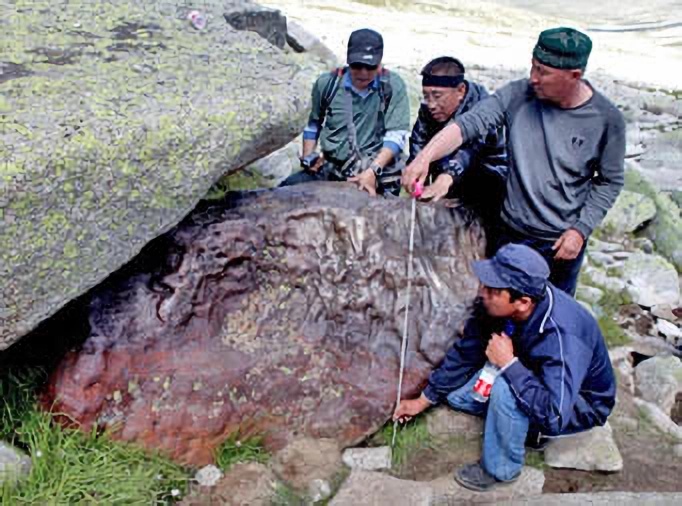
It came from space. Through a rock. Source: Special Topic Large Ground Meteorites - RocketSTEM
This is Akebulake.
Akebulake was found in 2011. It is one of several multi-ton nickel-iron alloy meteorites discovered in north west China since 1898. Two of them are the fifth and sixth biggest (publicly known) meteorites in the world. At 28 tons and 23 tons, they are significantly heavier than Akebulake.
None of them created a crater. Yet photographs of their paradoxical landing sites are very, very difficult to find.
At 18 tons, Akebulake is the ninth largest meteorite in the world. And the largest found under a rock.
You can probably guess that skipping-stone theory was resurrected to explain why none of them left a crater. And you can probably guess that Akebulake allegedly skipped like a flat stone until it settled into place. Under its rock.
All this is verifiable at List of largest meteorites on Earth - Wikipedia.
Not verifiable on Wikipedia is that Roessing Uranium Ltd wasn't the first to dig a suspicious crater around Hoba:
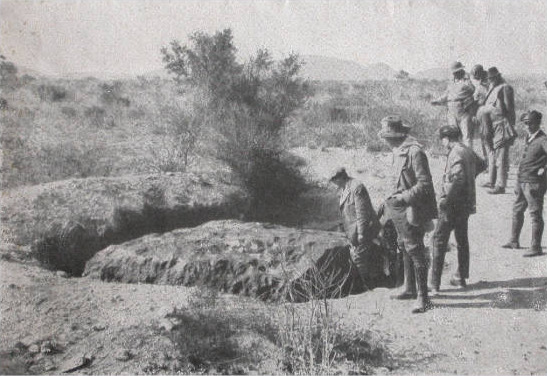
German scientists inspect the damage. 1929. Source: Mineralische Bodenschätze im südlichen Afrika via Minerals & Exploration: Hoba Meteorite Virtual Visit Namibia
From Das Otavi‑Bergland und seine Erzlagerstätten, Hans Schneiderhöhn, Zeitschrift für praktische Geologie, Vol 37 (Heft 6, 1929): pp 95-96:
At the time of the first visits by experts in 1925 it was already completely exposed on the sides, so that it could not be decided whether the limestone in the immediate vicinity showed contact phenomena.
Which was a pain for Otavi mining specialist Schneiderhöhn and many other scientists because Hoba's 'contact phenomena' presented a real mystery.
From The Grootfontein Meteorite, Willem J. Luyten. South African Journal of Science, Vol. 26, December 1929, pp. 19-20:
the crushing and compression of the limestone layers underneath can be easily seen, as well as their sharp bending upward on the sides.
Or at least, 'crushing and compression' and the odd-sounding 'sharp bending' could be easily seen before they were removed.
William Robert Feldtmann, General Manager of the South West Africa Company (SWAC) from 1926 onwards arranged the scientists' tours to Hoba. SWAC arranged tours from June through September 1929 for scientists attending the 15th International Geological Congress (XV Session) in Pretoria.
Among Hoba's visitors were these British and South African scientists:
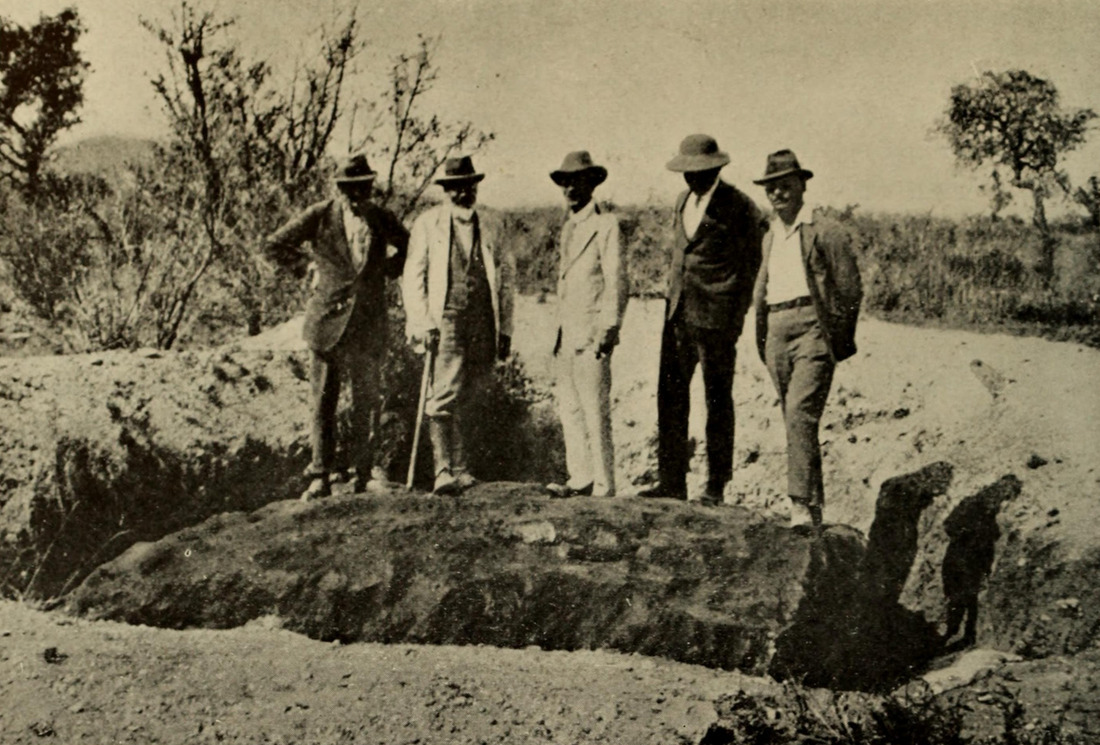
Posing on Hoba. 5 September, 1929. Source: Hoba (South-West Africa), the largest known meteorite 4
Another was American mineralogist Samuel G. Gordon, who noted evidence that an oxy-acetylene torch had been used to remove parts of Hoba. Gordon also suspected layers of iron shale had disappeared from Hoba's top surface. On paper, he played down the scope of the damage. And he introduced today's preferred scapegoat for Hoba's missing parts: the weather.
From The Grootfontein, Southwest Africa, Meteoric Iron, Samuel G. Gordon, Proceedings of the Academy of Natural Sciences of Philadelphia, Vol. 83, 1931, p. 253:
The meteorite has been damaged in the past by use of an oxy-acetylene blowpipe in endeavors to get specimens.
The 'iron-shale' has disappeared through erosion from the upper surface
However, also among the scientists who posed on Hoba was the chap with the walking stick. He was Llewellyn John Spencer, the British Museum's Keeper of Minerals.
Spencer swapped walking stick for pen to write the most detailed (publicly available) account of Hoba's structure. In it, Spencer described the real extent of Hoba's oxy-acetylene scar.
From Hoba (South-West Africa), the largest known meteorite:
The meteorite has unfortunately been disfigured all along one top edge by some stupid person with an oxy-acetylene blowpipe.
As souvenir hunters don't usually skulk around with oxy-acetylene gas cylinders, Spencer's description suggests work by people with serious intent, serious equipment and serious quantities of oxygen and acetylene. Not just someone snagging souvenirs from one warm section of the vast heatsink that is Hoba, but someone prepared to burn plenty of gas as they cracked along its 2.5m (8 ft) edge.
And while denying they were responsible, Spencer also hinted at who they might have been.
His tour hosts. SWAC - the South West Africa Company.
Spencer quoted a letter dated May 26, 1921. In the letter, W. R. Feldtmann's predecessor, Tobias Tönnesen wrote it to SWAC's London head office. Tönnesen set out the technicalities of dismantling Hoba.
He said:
"The stuff is very ductile, precluding blasting. We shall try a saw and eventually an oxy-acetylene flame."
'We' seems to have been Tönnesen's employees. In material assembled by Hoba historian PE Spargo, Tönnesen's oxy-acetylene investigation awaits 'Messrs Clarke and Hardy'. Clarke is most likely SWAC employee C.G. Courtney Clarke. Hardy seems to have worked at SWAC's metal assay lab in nearby Abenab. He is - possibly - Geoffrey Hardy.
If SWAC had the people and equipment to cut into Hoba, it also had the industrial network, transport links and technical motive to do so. And to do so for more profitable reasons than supplying souvenirs and samples to scientists and museums. SWAC was a major shareholder in the spectacular array of metal mines then positioned around this extraordinary chunk of nickel-iron alloy. Some are still there: Tsumeb and Abenab, while other mines closer to Hoba are now gone. Such as Asis and Klein Otavi.
SWAC also had the means and motivation to move l;arge chunks of Hoba. It was the prime shareholder in Otavi Minen und Eisenbahn Gesellschaft (OMEG) - the Otavi Mining and Railway Company. OMEG had built a rail line to link Otavi's mines with the sea port at Swakopmund:
That record-breaking infrastructure project required vast amounts of iron, steel and the best minds in metal engineering. Plus military support and a couple of genocides.
SWAC considered all this investment worthwhile in order to serve the Tsumeb mine:
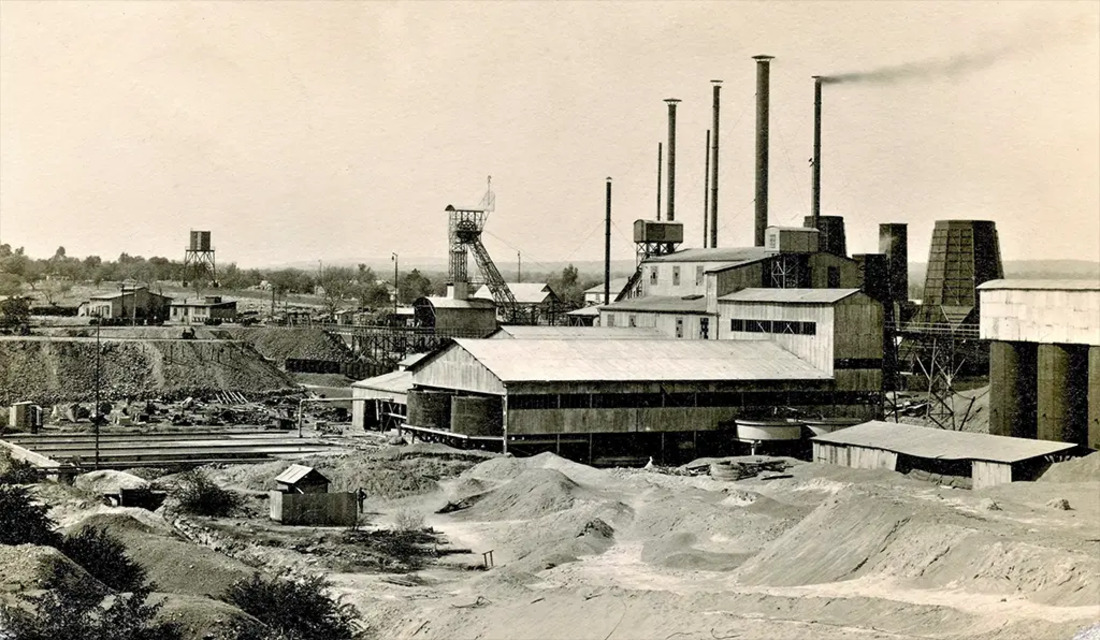
Tsumeb mine, 1926. Source: Geology of Tsumeb
OMEG also built a railway siding near to Hoba at Otjihaenene:
SWAC-owned mining and railway infrastructure around the Hoba Meteorite.
Key:
- Red line: Otavi-Swakopmund rail line
- Orange line: Otavi-Grootfontein branch line
- Blue marker: Hoba Meteorite
- Black marker: Mine, quarry, pit or shaft
- Red marker: Station or siding on Otavi-Swakopmund rail line
- Orange marker: Station or siding on Otavi-Grootfontein branch line
In revealing the extent of the damage to Hoba, Spencer added that the damage was inflicted surreptitiously. Given the bright light and noise generated by oxy-acetylene blowtorches and associated equipment, 'surreptitiously' presumably means 'in broad daylight'.
Spencer carefully suggested that SWAC hadn't stolen nickel from Hoba.
From Hoba (South-West Africa), the largest known meteorite:
Since all meteorites in South-West Africa are the property of the Government, nothing further was done in the way of mining for nickel.
But then, it wasn't just nickel that had gone missing. It was whatever Samuel Gordon suspected might have been on top of Hoba plus the enigmatic, missing 'contact phenomena'.
Soon after Hoba was discovered, a 2.5m (8ft) deep pit was dug around it to find its base. It's the dark area to the right in this photograph:
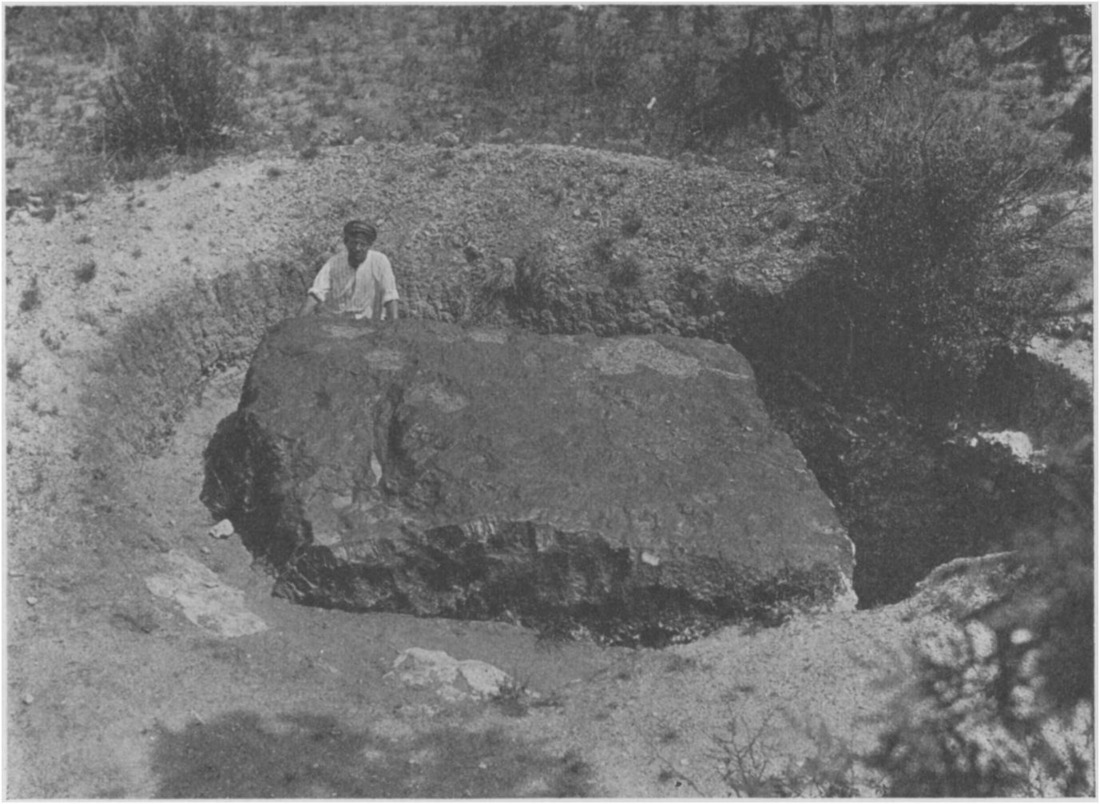
Probably Samuel G Gordon. December 1929. Source: The Grootfontein, Southwest Africa, Meteoric Iron, Samuel Gordon 1931, Proceedings of the Philadelphia Academy of Sciences, Vol. 83, pp. 251-256
The pit allowed scientists - and perhaps metals assayists - to get eye to eye with what was left of Hoba's missing contact phenomena:
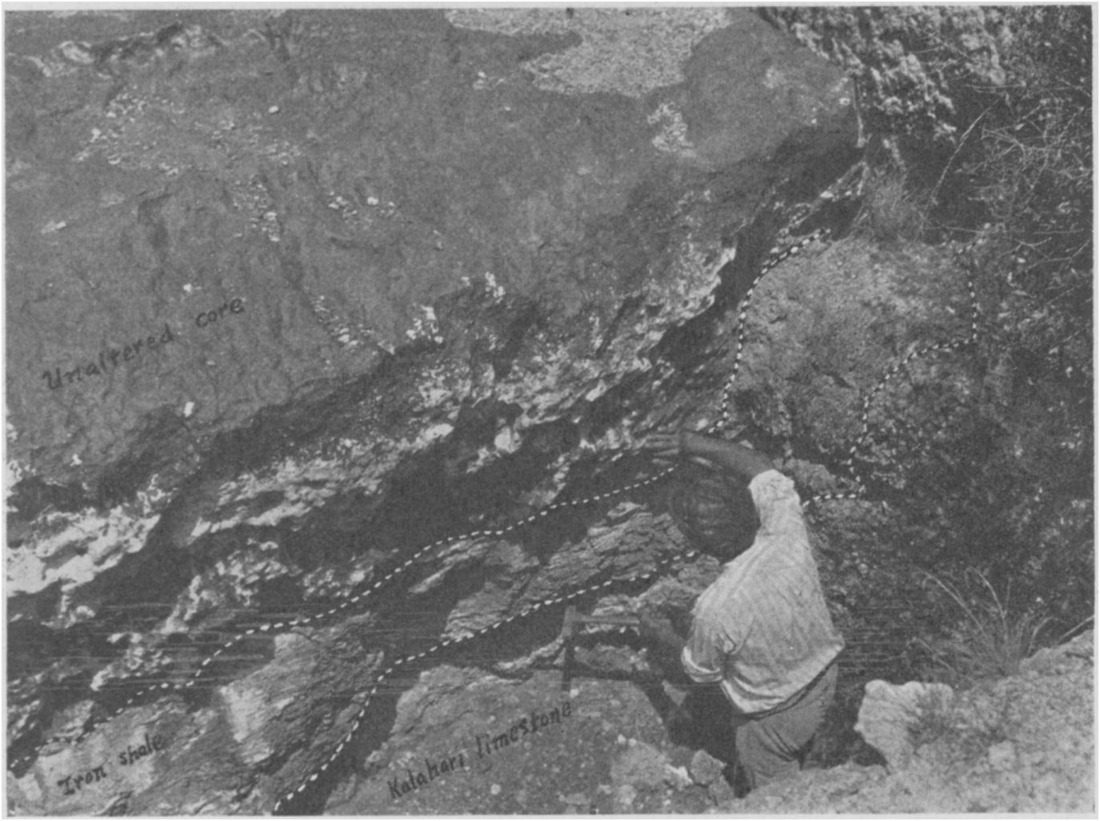
Gordon investigates beneath Hoba. December 1929. Source: The Grootfontein, Southwest Africa, Meteoric Iron
Added to the photo in front of him, the dotted lines indicate 'contact phenomena' and its sharp upturn in it to his right. The text in the bottom left of the photograph shows scientists were calling this part of Hoba's contact phenomena as 'iron shale'.
That iron shale is very, very interesting.
Describing his December 1929 investigation in his 1931 paper, Gordon confirmed Hoba's iron shale was laminated.
From The Grootfontein, Southwest Africa, Meteoric Iron:
['iron-shale'] in the pit is seen to curve about the core in laminations which form a zone 22 to 50 cm. in thickness.
And:
Thick laminations of 'iron-shale,' due to weathering, sheathed the meteorite to a thickness of 22 to 50 cm.
Gordon might have blamed the weather for rusting the thin plates of nickel-iron between the slightly thicker plates of calcite (calcium carbonate) that surrounded Hoba. But he could not blame the weather for creating laminated plates in the first place.
Gordon was hinting that Hoba was manufactured.
Simultaneously, former German colonial Government Geologist Dr Paul Range, with geologist Dr R. Schreiter, published Der Hoba-Meteorit in Südwestafrika" (The Hoba Meteorite in South-West Africa), Centralblatt für Mineralogie, Geologie und Paläontologie, Abteilung A. In eight photographs between pages 390-398, they also showed that Hoba's remaining iron shale was laminated.
Just visible above Gordon's right forearm is a patch of iron shale whose details fascinated LJ Spencer. Spencer made that patch the central image in a presentation he gave to London's Mineralogical Society on 9 June 1931:
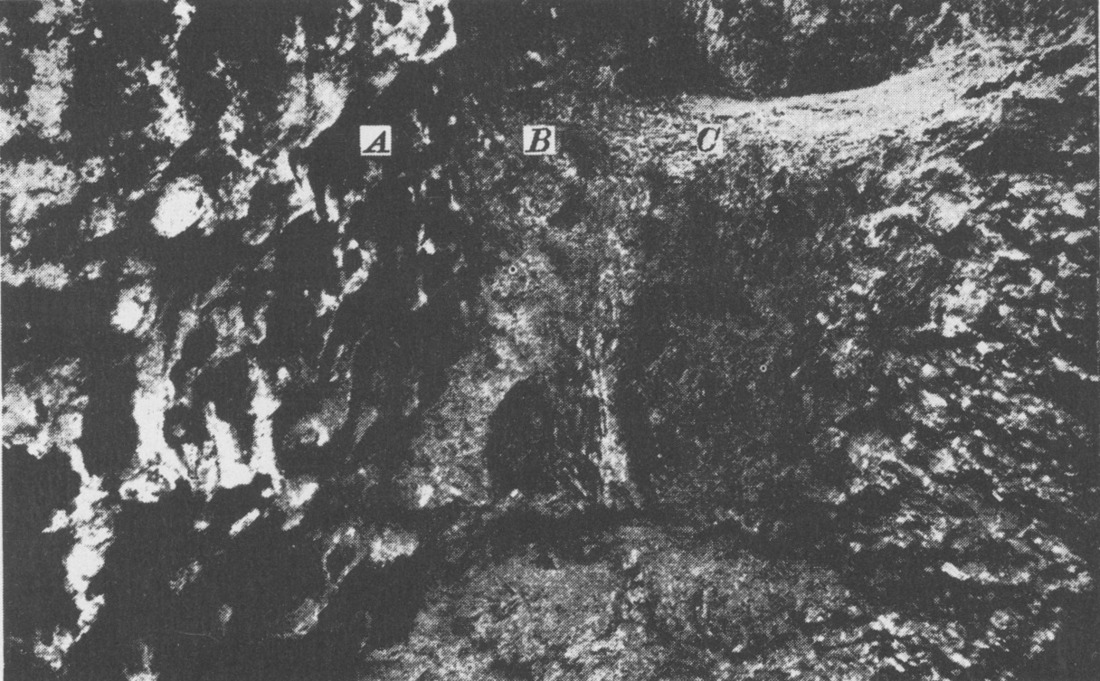
Hoba left, 'iron-shale' centre, limestone right. Source: Hoba (South-West Africa), the largest known meteorite
What that very poor photograph is trying to show is that the material immediately below the letter 'B', in the centre, is uneven in a repetitive sort of way. It was the remains of laminated 'iron shale'.
If he wasn't already, Spencer had become a keen student of Hoba's laminated 'iron shale'.
From Hoba (South-West Africa), the largest known meteorite, LJ Spencer, March 1932, Vol XXIII, no. 136, p6:
The mass is embedded in a white, soft and porous surface limestone (Kalahari Kalk), from which it is separated by a layer, one foot in thickness, of laminated “iron-shale” (figs. 3 and 4). This “iron-shale” is dark-brown to black in colour, with a dark-brown streak, and it is magnetic. It consists largely of limonite, with some magnetite and perhaps also trevorite (NiFe₂O₄). It shows green nickel stains and is seamed with white calcium carbonate from the surface limestone. The lamination of the shale follows the contour of the meteorite, being vertical at the sides (fig. 3) and horizontal at the base (fig. 4). There is a sharp separation between the shale and the metal, though the metal shows a little rusting and scaling on the surface. The rock underlying the surface limestone at this spot is granite
There is no crater.
Spencer suggested to his audience that Hoba's "iron-shale" was merely rust, albeit exotic space-metal rust. This had combined with Earthly limestone which had somehow 'seamed' its way between Hoba's exotic space-metal plates. But between the lines, Spencer was confirming Gordon: Hoba had been manufactured.
It's not surprising a multi-ton chunk of nickel-iron alloy wrapped in plates of nickel-iron alloy and ceramic was found 3km (2 miles) north of the Otjihaenena rail siding in 1920. Hoba sits in between both the Uitsab-Harasib-Nosib mineral belt and the Olifantsfontein mining cluster and the railway line built to service the Otavi area's vast metal and mineral wealth.
A now barely used trackway ran south-west right past Hoba towards the Guchab/Rodgerberg/Kombat mineral and mining belt. And to OMEG's rail line.
It's shown in grey dashes on this map:
1920 was a busy time around the Hoba Meteorite.
Key:
- Red line: Otavi-Swakopmund rail line
- Orange line: Otavi-Grootfontein branch line
- Blue marker: Hoba Meteorite
- Black marker: Mine, quarry, pit or shaft
- Red marker: Station or siding on Otavi-Swakopmund rail line
- Orange marker: Station or siding on Otavi-Grootfontein branch line
Zoom in for:
- Grey dashed line: Usable unnamed track past Hoba
- Light grey dashed line: Traces of continuation of unnamed track past Hoba
- Purple shaded area: Kombat-Guchab-Rodgerberg mineral belt and mines
- Green shaded area: Uitsab-Harasib-Nosib mineral zone and mines
- Brown shaded area: Olifantsfontein mine cluster
Hoba was the black stone at the centre of all this - the Kabba at the Mecca of metal mining.
The map invites a further suspicion: the trackway that passes Hoba heads south-west towards the mining settlement called Kombat. Before it gets there, it disappears.
Look at that disappearance location on Google Maps... There are a couple of farm buildings, a curiously large number of tracks radiating outwards from and around the area, and cropmarks that suggest the grid (or platten) layout of a lost settlement or facility:
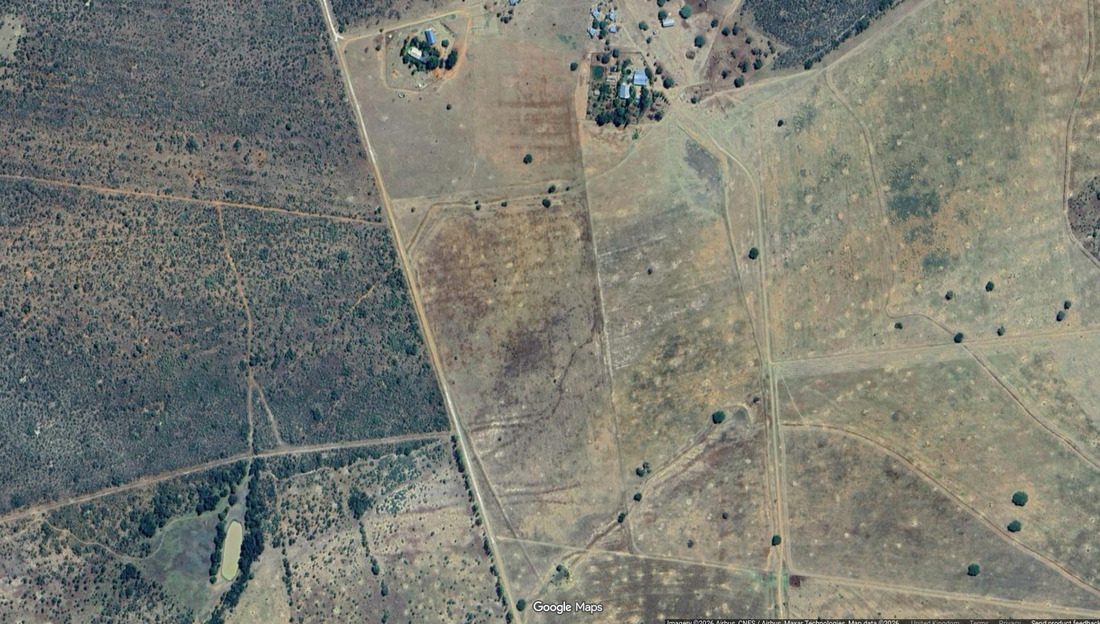
Cropmarks between Hoba and Kombat mine. Source: Google Maps
If you have read Spencer's 1931 paper you may remember that Hans Schneiderhöhn described seeing a bright fireball over the area on 16 September 1917. And that Spencer bothered to mention this and note it had nothing to do with Hoba.
18 months after presenting Hoba's laminated iron shale to London's Mineralogical Society in 1931, Spencer presented to the Royal Geographical Society. He told them iron shale had been found at several craters (Meteor Crater, Arizona; Odessa Crater, Texas; Henbury crater complex, Australia; and Campo del Cielo crater complex, Argentina).
That iron shale, he said, is strong evidence that meteorites made those craters. That iron shale is the remains of meteorites.
He may even have sounded convincing.
Craters with no iron shale are just anomalies, Spencer explained. This deftly side-stepped objections from Estonia, where neither meteorites nor iron shale had been found at the Kaali crater complex. It also ignored Estonian 'folklore' that claimed Kaali had been made off-limits - literally walled off - while lights and strange quarrying-like noises emanated from inside.
And, despite his earlier interest in Hoba's iron shale, Spencer avoided describing Hoba in any detail. He merely said that Hoba's missing crater made Hoba an anomaly too.
With this 16 January 1933 presentation - Meteorite Craters as Topographical Features on the Earth's Surface - Spencer solved several problems.
One problem was the big craters the public were beginning to learn about:
Explained away. Spencer's list of craters. Plus black and purple anomalies.
Key:
- Blue marker: Crater with iron-shale
- Purple marker: Crater with no iron-shale
- Black marker: Hoba meteorite: iron-shale with no crater
With his 1933 presentation Spencer fixed in public minds their current understanding that 'meteorite equals crater' and 'crater equals meteorite'.
He also left scientists with opportunities to make a living writing daft theories about his theory's anomalies.
Even more helpfully, by marketing iron-shale as the rusty remnants of meteorites Spencer distracted the public - and many scientists - from noticing how odd Hoba's laminated 'iron-shale' really was.
He weathered its meaning away.
Today, Hoba's laminated 'iron-shale' is barely mentioned. Not even as the degraded mess created when water interacts with nickel alloy plates that have been laminated with variants of calcite.
Nor that iron-shale looks like an early version of Composite Ceramic Armour:
Although, not always. Source: What Tank Armour Can (& Can't) Do | Evolution of Armour
A well-known version of which is Chobham Armour.
From Chobham armour - Wikipedia:
Chobham armour is... composed of ceramic tiles encased within a metal framework and bonded to a backing plate and several elastic layers.
Variant forms of composite ceramic armour include Electric armour. Hoba's mix of a massive metal base wrapped in alternating plates of metals and ceramic even hints at a still widely-used electronic component:
Such as a surface-mounted multi-layer ceramic capacitor. Source: Video 10 Capacitor Units and Construction
The possibility that Hoba was originally a lightning conductor with a multi-layer ceramic capacitor (MLCC) built into its base would clarify an enigma in the earliest public mention of Hoba. This was a report by American mineralogist Dr. Charles Palache's. A British Museum record says when Palache inspected Hoba on 6 April 1922, he measured Hoba as 8 m (26 ft) high.
From Catalogue of Meteorites, George Thurland Prior, British Museum, 1923, p73:
Hobart West, near Grootfontein, Bechuanaland, South West Africa. Iron. A mass estimated at about 40 tons and measuring about 2½ × 2½ × 8 metres (verbal communication from Dr. C. Palache, (1922) was found and has not been moved.
Described as "one of the most eminent crystallographers and mineralogists in the world", Palache probably knew the difference between 8m and 0.8m. His dimensions suggest a mast or pylon stood above Hoba. It may explain why Gordon thought a top layer had been 'weathered' away. And why someone did so much damage to its top edge.
Unfortunately, absent details of Hoba's original structure, the military secrecy around the development of composite ceramic armour seems the best-fit explanation for Hoba's post-WWI find-time, its enigmatic structure and the meteorite misdirection that emerged after 1931.
From Types of Armour - Norfolk Tank Museum:
Chobham Armour
The manufacture of Chobham Armour is still covered by the Official Secrets Act and little is known about its specifics. It is believed to be made from many layers of different energy absorbing materials compressed together under extreme pressure and heat to make a very dense material. This material is then added in blocks to the exterior of a vehicle.
From Ceramic armor - Wikipedia:
Tests as early as 1918 demonstrated the potential of ceramic armor
Its first operational use was not until the Vietnam war.
It seems reasonable then, to wonder if:
- Kombat is the aptly-named remnant of a research facility that assembled and tested sophisticated armour plate out of sight during the First World War.
- And if material was removed from Hoba because it was too useful for the public to see.
Even today, serious geological publications promote Hoba's laminated iron shale as iron oxide. As rust.
From Hoba: The World's Largest Meteorite:
An abundance of iron oxides in the soil around the meteorite suggests that it was much larger than 66 tons when it landed and has suffered significant losses from oxidation.
Samuel Gordon estimated Hoba's original weight by measuring how much laminated 'iron shale' might have been removed.
From The Grootfontein, Southwest Africa, Meteoric Iron:
The weight of 'iron shale' formed by oxidation of the meteorite was probably fifty tons, which would indicate the weight of the meteorite at the time of fall to have been about one hundred tons.
Gordon's estimate ties in with reports of Hoba's steady weight loss. First estimates weighed it between 87 and 100 tons; while later reports weighed it at 66 tons, then 61 tons, then 60 and now 50+ tons.
Gordon even hinted that some unknown agency had tried to hide Hoba before its 1920 announcement.
From The Grootfontein, Southwest Africa, Meteoric Iron:
The meteorite was buried in the superficial calcareous tufa (Kalahari Kalk), which had apparently been deposited about it since it fell.
Several other clues point to Hoba being a technical remnant of technologies available during the First World War. And of attempts to direct attention away from those clues.
Spencer, for example, dismissed as inaccurate Harvard astronomer Willem J. Luyten's reports of Hoba's composition. Luyten said Hoba's high nickel content made it very different to other metal meteorites. At approximately 17% nickel to 83% iron, Luyten claimed Hoba was:
about as hard and as tough as the steel used in locomotive wheels, about the toughest steel used.
The first person to publicly say Hoba's iron shale wrapping was laminated was former Government Geologist of German South-West Africa, Dr. Paul Range 5. Not only did Range work with German Colonial surveys mapping the area's metal and minerals deposits, he meticulously catalogued its meteorites 6.
So Spencer took Range at his word when Range told him this bombshell:
the Hoba meteorite was certainly not known previous to the war of 1914-18.
As former Government Geologist of German South-West Africa, Range would probably know. Especially as Hoba was located in a very busy, very well prospected area famous for its metal mining and processing.
Among many things not said about the enigma of Hoba is that the Tsumeb region does get rain.
Which means that anyone who wanted to continue destruction of remnant evidence of Hoba's laminated iron shale simply had to help rainwater pool around its base:
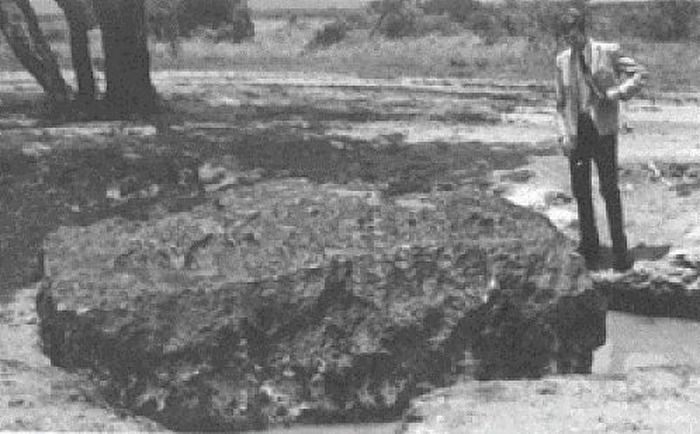
Hoba circa 1960. Source: Mineral & Exploration Hoba Meteorite Virtual Visit Namibia
For as long as they could.
At least until the time of the Vietnam War:
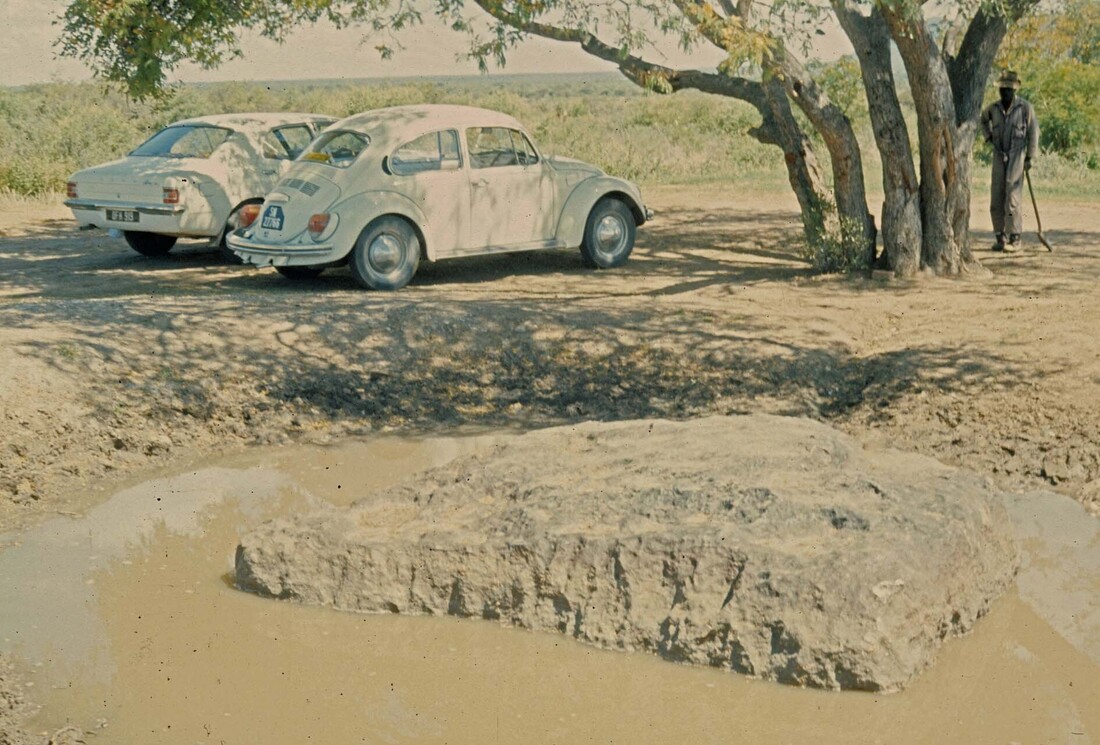
Hoba circa late 1960s or 1970s. Source: Hoba meteorite, Grootfontein Constituency, Otjozondjupa Region, Namibia
Knowing the annual wet and dry cycle would eventually hide the stain of hidden military science under a stain of rust:
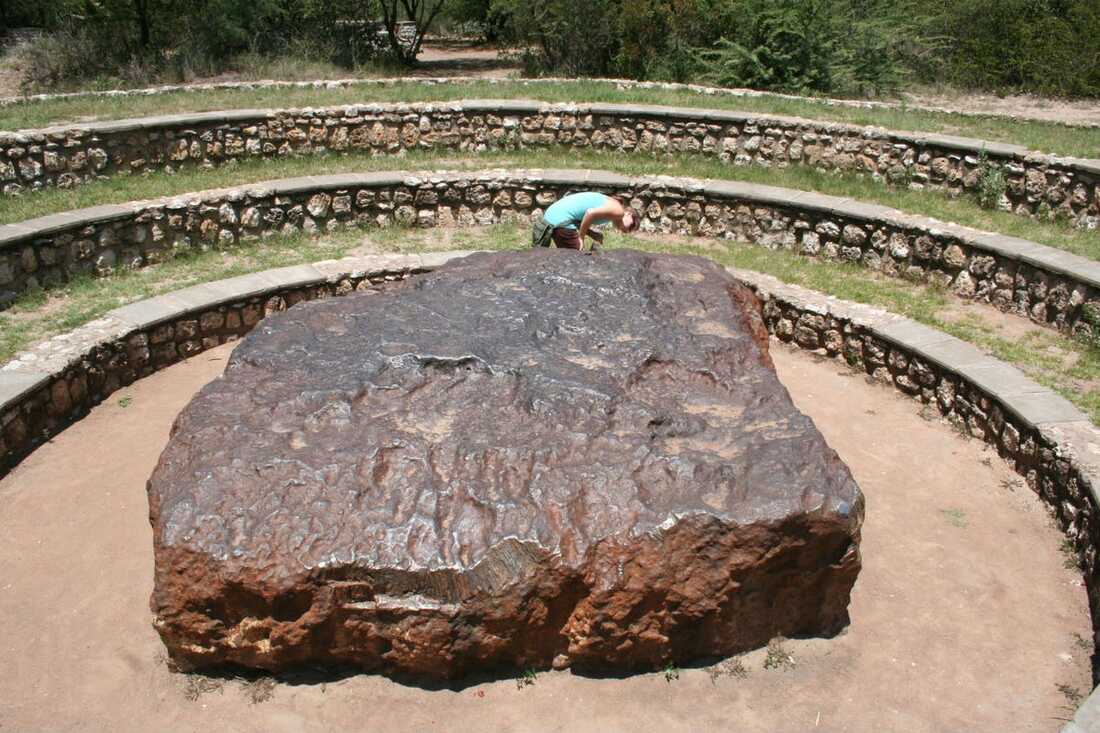
No matter how hard you look. Source: The largest meteorite on earth
Despite removal of evidence and cover ups of remnant evidence, evidence of Hoba's hidden story occasionally resurfaces:
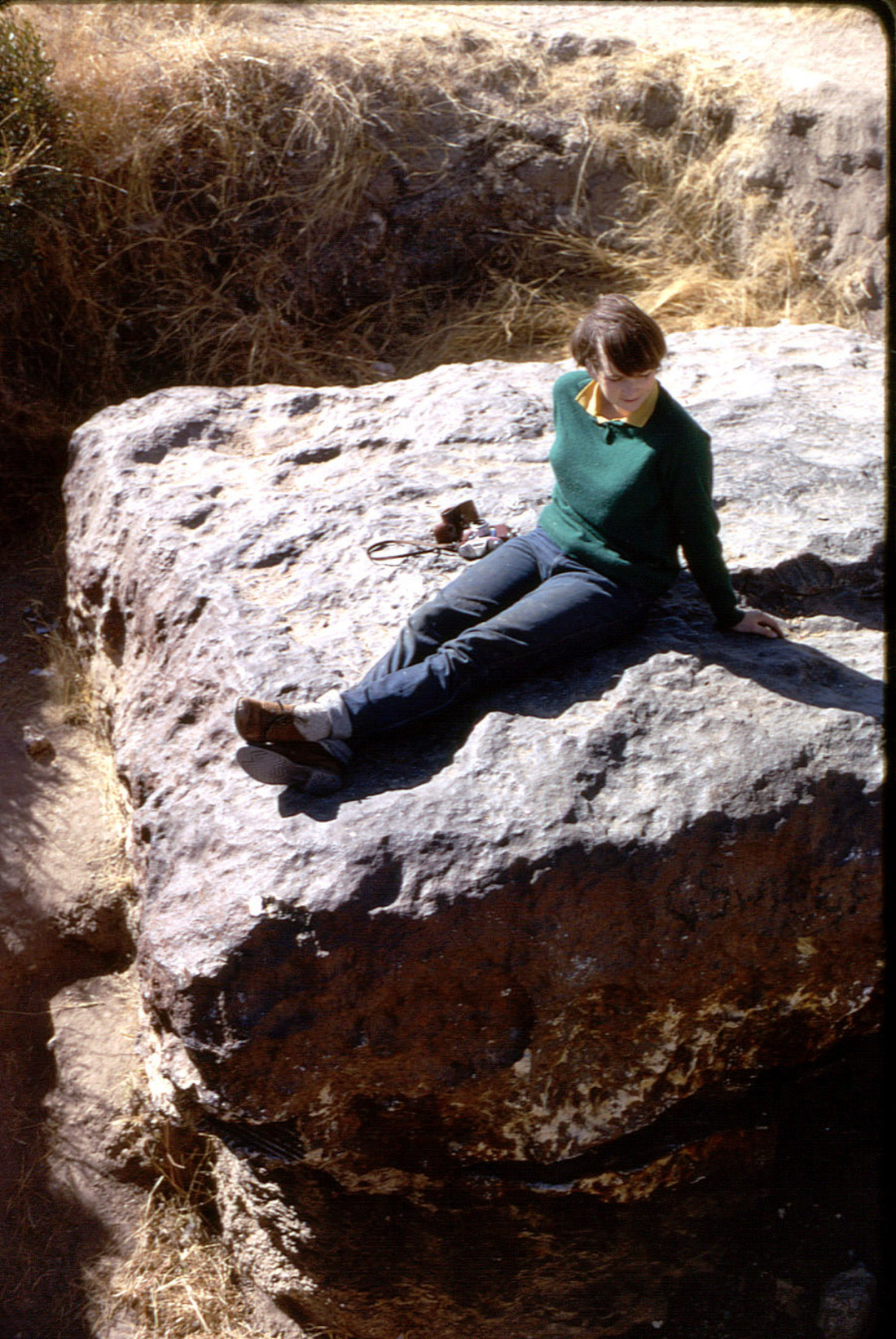
Hoba meteorite 1967. Source: Hoba meteorite - Wikipedia
The photograph shows Hoba's anomalous underside. A black sheet apparently emerges from part way down the white underside. It may be a protective plastic sheet or a layer of laminate 7. Below it, in the bottom left corner, is a grey ridged or layered area.
As this photograph is the only extant modern image of Hoba's underside, the close-up below links through to a slightly higher definition close-up:
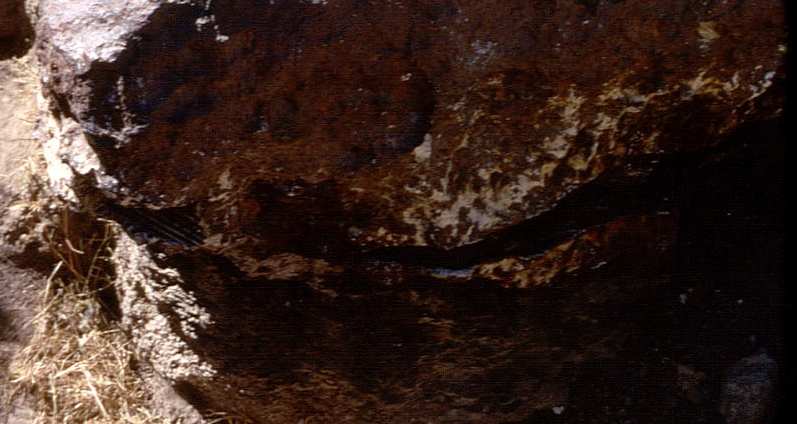
Layers beneath Hoba: close up. 1967.
I've avoided enhancing the image so don't expect much. But it offers as good a look at Hoba's problematic underside as is likely to be had. And it shows the colour and ridged nature of material buried beneath Hoba.
As it happens, you don't have to examine this 1967 photograph to realise parts of Hoba look like the anomaly LJ Spencer said it was:
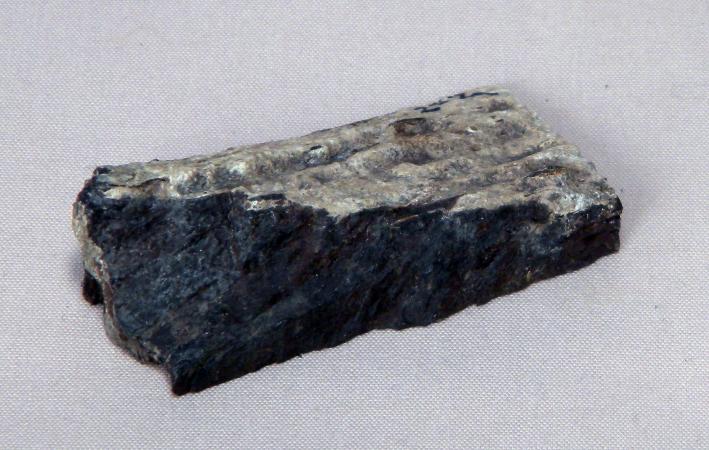
Because it seems to be metal laminate. Source: Fragment of the Hoba meteorite on exhibit at the Planétarium
Montreal Planetarium cherishes its copyright. But there's nothing to stop you downloading this image and enlarging for yourself.
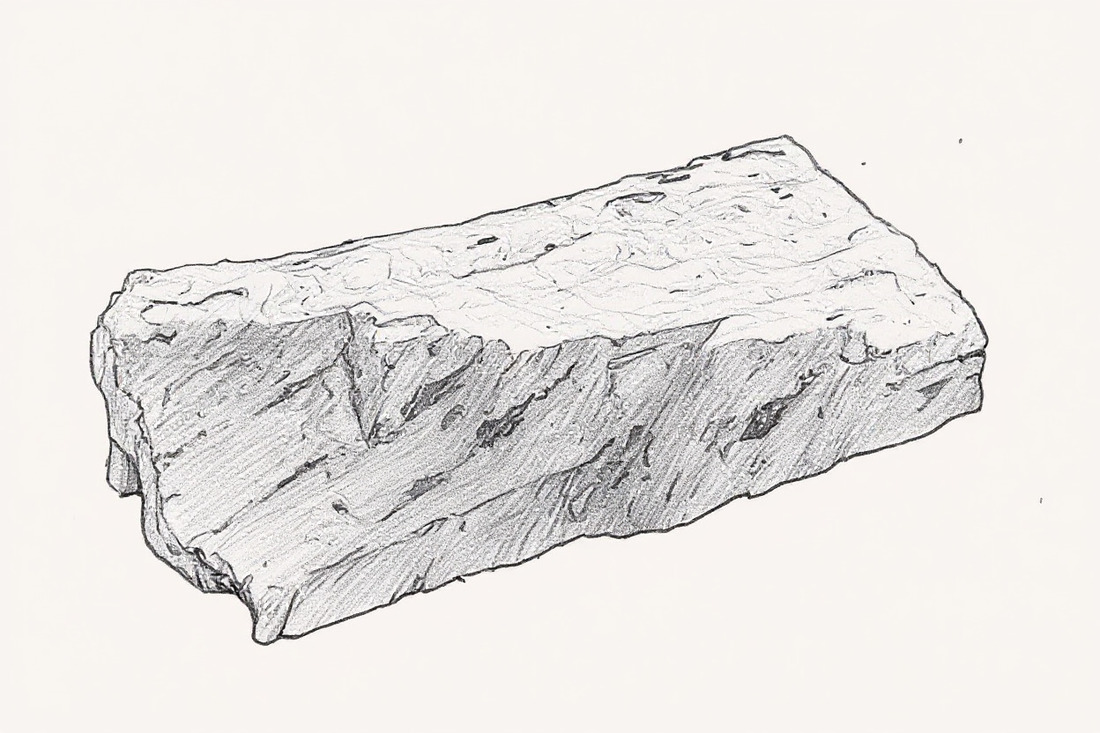
If you do, you should see this extraordinary, natural, meteoritic nickel-iron alloy is made of six - possibly seven - laminated plates.
Easy to see are the edges of lamination planes along the upper surface. Much harder to see are traces of the same lamination planes within its dark-coloured interior. Maybe this sketch helps:
One or more of the techniques used to hide Hoba's real structure were also used to hide elements of each of the biggest iron meteorites in Wikipedia's list. From more mis-described 'iron shale' to rewritten physics; from water-baths to fires; from removal of ground evidence to - literally - cutting them up and burying the parts; just about every technique used at Hoba has also been deployed to hide the nature of other metal meteorites.
Taken together, the world's biggest meteorites appear to be the remains not just of one military secret but of a set of technologies.
In the next part, we look at more evidence that some meteorites are remnants of damaged armour plate.
© All rights reserved. The original author/creator of each image, video, quote or text retains full ownership and rights.
-
Though not as ridiculous as the 'rotating meteorite' theory once used to explain how the Tucson Ring Meteorite became ring-shaped. ↩
-
Gancedo, Campo del Cielo, Argentina ↩
-
El Chaco, Campo del Cielo, Argentina and nearby La Sorpresa. ↩
-
One AMNH guide dates this photograph to 1901. Maybe so, but if so, then this photography up-ends the official Hoba narrative even more than the evidence presented here. ↩
-
Range, P., and R. Schreiter. 1931. "Der Hoba-Meteorit in Südwestafrika." Centralblatt für Mineralogie, Geologie und Paläontologie, Abteilung A: 390–398. (8 figures). Cited in Mineralogical Abstracts, vol. 5, p. 11. If you can find the original, please publish it. ↩
-
Meteoriten aus Deutsch-Südwestafrika (Meteorites from German South-West Africa), Paul Range, Mitteilungen Deutschen Schutzgebieten (Communications from the German Protectorate), Vol 26, 1913, pp 341-343. ↩
-
The black layer's position suggests Hoba's upper tile has been lifted at some time enabling inspection of the mass below. Contrary to the claim Hoba has never been moved. ↩
 More of this investigation:
Desert Forensics,
More of this investigation:
The Reformation Was a Reformatting,
More of this investigation:
Misunderstood Technology
More of this investigation:
Desert Forensics,
More of this investigation:
The Reformation Was a Reformatting,
More of this investigation:
Misunderstood Technology