Skillful trepanning. So skillful, the people who did it couldn't have done it. Sun 20 March 2022
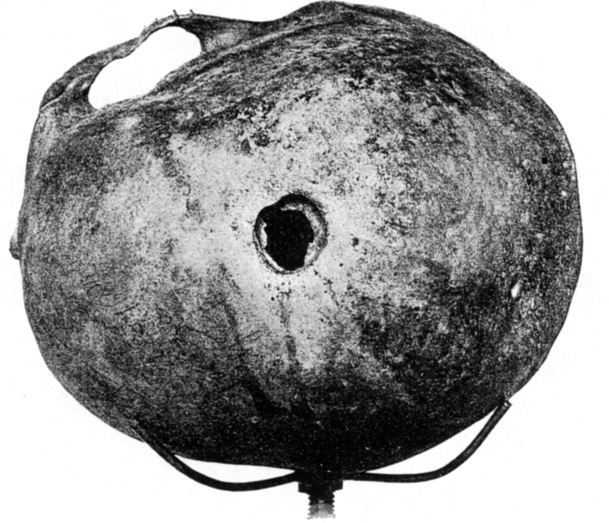
A very neatly trephined female Tarahumare/Rarámuri skull. Source
'Trephin' is another word for 'trepan'. The precision of the removal hole in this Tarahumare/Rarámuri skull suggests advanced surgical skills:
Highly advanced surgical skills. Source: Continuum
In Trephining in Mexico, American Anthropologist, 1897, pp 389-396, authors Carl Lumholtz and Aleš Hrdlička say:
One would expect that trephining among the Tarahumares would have been done in the most primitive way, by scraping; but the almost circular form of the opening, and its perpendicular walls, which show no signs of beveling, do not admit of this conclusion. The senior author has never found among the Tarahumares any implement which afforded a suggestion that it had been used for such an operation. At present they do not use any stone implements except plowshares
Lumholtz and Hrdlička suggested the Tarahumares/Rarámuri had subsequently lost their trepanning skills.
That's one explanation.
Regardless, the Tarahumares/Rarámuri have not the lost their long-distance running skills.
Or at least, those that survived haven't.
Lumholtz and Hrdlička also noted the shape of her nose bone:

Trephined Tarahumare female skull from the side. Source
From Trephining in Mexico:
The nasal bridge is rather low and very concave.
We've seen that bridge-of-the-nose shape before:
Faces reconstructed from skulls found in Carsington cave, England. Source: Time Team Carsington, Derbyshire S10 Ep03
The Carsington cave bodies were apparently disarticulated - butchered - by something other than humans.
Perhaps the Tarahumares were also being trepanned by something other than humans. Something with highly advanced surgical skills.
Many trepanned skulls show the victim survived the operation.
From Presentation of the Trepanned Skull Labelled MO-90:
Surgical skull trepanation is known on almost every continent
Despite the fact that it is a complicated, life-threatening procedure, more than a half of patients survived for a long time.
3⁄4 of 130 [Hungarian] trepanation cases were men
94% of [Hungarian] trepanations occurred on the forehead (os frontale) and on the frontal part of the parietal bone (os parietal), in 3⁄4 of the cases on the left side of the skull. This suggests that the trepanation was preceded by traumatic injury (assault).
Traumatic head injury has even been a prerequisite for curious brain researchers in need of subjects that won't tell tales.
From Eduard Hitzig - Wikipedia:
In 1870, Hitzig, assisted by anatomist Gustav Fritsch (1837–1927), applied electricity via a thin probe to the exposed cerebral cortex of a dog without anesthesia.
However this was not the first time Hitzig had experienced the interaction between the brain and electricity; earlier in his career as a physician working with the Prussian Army, he experimented on wounded soldiers whose skulls were fractured by bullets. Hitzig noticed that applying a small electric current to the brains of these soldiers caused involuntary muscular movement.
Medical research in the ruins of former empires may explain the number, technical skills, and silence surrounding many trepanned skull finds.
From Presentation of the Trepanned Skull Labelled MO-90:
There are a large number of cases, which is especially true for Hungary. Józsa and Józsa & Fóthi estimates that there are 150.
Unfortunately, many are unpublished.
Perhaps the high survival rate tells us trepanning was more about research than direct medical care:
Crack 'em open. Source: Westworld S02 Ep05
More:
See Cruel experiments (Russian), Andrey Sklylarov, about 3/4 through the text (English translation)
The Tarahumara/Rarámuri's home state of Chihuahua also offers many geology clues to a different version of humanity's history.
Possible Tarahumara/Rarámuri area of origin.
© All rights reserved. The original author/creator of each image, video, quote or text retains full ownership and rights.
 More of this investigation:
The Mutant Chimp Gets a Brain
More of this investigation:
The Mutant Chimp Gets a Brain
 More by tag:
#Manimal Farm
More by tag:
#Manimal Farm